 |
By A. Thornton Bishop, Chairman, Planning BoardThe Sunday Sun, April 28, 1946 |
 |
PART V
1930 -- 1945
Administration Becomes a Full Time Job
According to the Federal Census, Teaneck's growth in population took an exceptional spurt in 1920 from 4,192 to 16,513 in 1930. Although the increase was 400 per cent, the demands for municipal service multiplied to a greater degree than the population ratio. These demands were met by methods which were adopted without the strictest regard for economy. To meet the challenge of exigent circumstances, the Township Council resorted to precipitant action.
Conditions In 1930
During this period many concrete streets were built, long stretches of them passing by unimproved properties. Lateral sewer connections awaited development of the land, the assessments in the meantime being held in abeyance. In 1928 the Township paid a total of $50,000 for engineering fees. In 1929, $10.650 was spent for attorney's fees and $10,040 went to auditors.
In 1930 Teaneck had only ten paid firemen and a part-time Chief, who was not in the Township during business hours. The Fire Department's equipment consisted of three one-ton hose trucks carrying chemical tanks, one cities service ladder, and two pumpers with an aggregate capacity of 1,350 gallons per minute. The National Board of Fire Underwriters rated the Township in Class E;,
The original setup of the Board of Health consisted of the Committeemen, an assessor of the Township, a doctor, and a secretary. The assessor generally took care of all vital statistics and complaints, and acted as secretary to the Board.
Need for Full Time Man Seen
It is obvious that the details of government so increased that they far outstripped the capacities of officials who could devote only their spare time to them. It was no longer a job to be administered as an avocation. It demanded the full time attention of individuals with professional skills.
In the spring of 1930 the Teaneck Taxpayers League began an active campaign for the adoption by referendum vote of the New Jersey Municipal Manager Act. In a house to house canvass to secure the required number of signatures to a petition calling for the referendum, four times the number required were obtained, on the evening of September 10, 1930, the elements of the proposed change of government were debated at a general mass meeting held in the Teaneck High School Auditorium, and six days later, the referendum proposal was adopted by a majority vote of the Township.
Volcker Named Manager
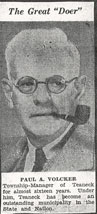 The first Council elected under the Municipal Manager Act took office on November 11, 1930. Its first act was to appoint Paul A. Volcker as Township Manager. Mr. Volcker, a civil engineer by profession, had served the City of Cape May as City Manager for the previous five years, and had been recommended by his experience in public service in New York and Pennsylvania. Devoting his full time to the office, Mr. Volcker serves also as Commissioner of Public Safety and is directly responsible for the efficiency of the Fire and Police Departments.
Reorganization of all municipal services became the first duty of the new Manager. Modern equipment was purchased and installed effecting savings in labor costs while increasing the alertness of the services to the public. International Business Machines were adopted to supply a punch card system to the preparation of the tax rolls by the assessor. Other machines typed the tax bills, computing the items mechanically, and so avoiding the human vulnerability to error.
Fire Department Changes
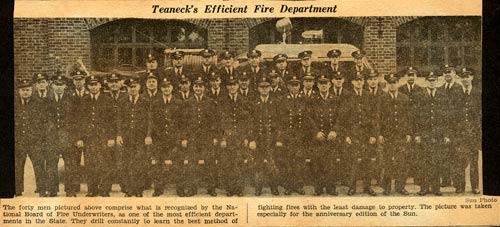
In 1932 the Township began to convert its volunteer Fire Department into a full paid organization. The need for additional protection occasioned by the rapid increase in number of homes necessitated a three-fold increase in cost, from about $34,000 in 1932 to $102,350 as of today. This increase in expense, however, has been alleviated to a great extent by the savings to each taxpayer in the lower rates for fire insurance, because of the fact that Teaneck's classification has been raised by the National Board of Fire underwriters from "E" to "B." A further extension of the fire alarm system, planned for the near future, will complete the prerequisites for a Class "A" rating.
History of Department
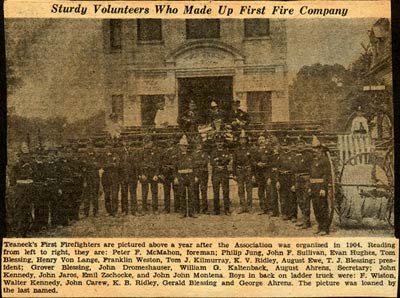
The work of the Teaneck Fire Department has lived in the records of gallant service from the formation of the first Company in 1904, with quarters at the southwest comer of Teaneck Road and Forest Avenue. The second Company, known as the Cedar Volunteer Firemen's Association, was founded in 1908, and was sheltered temporarily in the barn of Joseph Douglas on Linden Avenue until the fire station on Kenwood Place was completed in 1912.
The third Company, also a volunteer organization, and known as Teaneck Hose Company No. 1, was formed in 1911. Its first quarters were in a barn on Teaneck Road, but when the present fire station was erected n 1913, the Company's truck was moved in. In the same year, the fourth Company was organized, and was known as the Glenwood Park Volunteer Firemen's Association. Its apparatus was housed originally in John J. Kennedy's blacksmith shop until quarters could be provided on Glenwood Avenue in 1914, The present station was built in 1923.
Fire Alarm System Installed
Until this time all fires were reported by telephone to Police Headquarters, which was located across the street from the central fire station. It was not until 1923 that Fire Headquarters received the benefit of a telephone installation. In 1926 sirens were mounted on all four firehouses as a means by which to summon firemen. This system was superseded in 1932 when alarm boxes were located in various parts of the Township, and a code-blowing air whistle was installed on the central station. Direct telephone wires; one from the Hackensack exchange and another from the Englewood exchange, were also made available at this time. These two telephones are used to receive alarms of fire and have no numbers. They are reached by asking the operator for "Teaneck Fire Department Emergency."
Each Company was organized primarily to serve its own particular part of the Township, but the four were consolidated into one department in 1922. K. V. Ridley was appointed Volunteer Chief of the Department at that time and served until 1932 when Frank A. Murray, the present Chief, was employed.
Installs Advanced Methods
One of the advanced methods instituted by Chief Murray was the broadcasting system whereby all communications, alarms, and instructions are simultaneously sent to all fire stations. A Fire College was organized where the personnel of the Department is trained In the improved methods of fire-fighting. Equipment now includes an aerial ladder truck by which means a stream of water can be poured into the top floor of a six-story apartment house; a searchlight wagon for facilitating operations at night; a rescue truck which has answered many calls for emergencies other than fire; and a joint radio communication with the Police system.
Low Fire Loss Here
The low fire loss in the Township serves as a good means to measure the efficiency of the Department. The average five-year per capita loss has been 74 cents against a national average of about $1.70. In 1944 the per capita loss was 80 cents against a national average of $3. The average loss per building fire was $177 against a national average of $289. The Municipal Year Book of 1943 shows that only thirty municipalities out of 774 reporting have a better class rating than does Teaneck, in spite of the fact that Teaneck has not purchased an important new piece of apparatus for sixteen years. Under the direction of Chief Murray, existing apparatus has been reconverted, and new apparatus has been constructed out of second hand chassis and parts, all of which has given, and is giving, excellent service.