
 |
By A. Thornton Bishop, Chairman, Planning BoardThe Sunday Sun, April 28, 1946 |
 |
PART IV
Teaneck's Outstanding Citizen
William Walter Phelps, who became Teaneck's outstanding citizen, purchased the old-fashioned Dutch farmhouse, known as .the "Old Garrit Brinkerhoff Homestead" of Revolutionary days, about 1865, and became a legal resident of the state of New Jersey two years later. For almost the thirty years which followed, he gave all the time he could spare to the development of his country estate which grew year after year until it reached from the Hackensack to the Hudson, a distance of nearly five miles, and consisting of almost 2,000 acres. He took pride in the ownership of his green meadows and stately trees, and he improved and beautified them, planting thousands of saplings to line and shade more than 40 miles at private roads.
Native of Pennsylvania
A Native of Pennsylvania, Mr. Phelps was born in 1839, the son of John Jay Phelps, a leading merchant and financier of the early nineteenth century. The family came from England and landed in 1930 at Hull, in Massachusetts. They were active in politics and public affairs from the beginning, William's great-grandfather representing the town of Simsbury for thirty years in the Legislative Assembly of Connecticut. Following a period in which he was interested in a newspaper, John Jay Phelps went west to the coal mining region in Pennsylvania, and participated in numerous business adventures, being instrumental in the building of the Delaware, Lackawanna and Western Railroad, of which he was the largest stockholder and its first president
William Walter Phelps was educated at the Mount Washington Institute, in New York, the Golden Hill School, near Bridgeport, and at Yale. Here he won the prizes for Latin composition, English composition, and for debate. Upon his graduation he was married to Ellen Maria, the daughter of Joseph Earle Sheffield, founder of the Sheffield Scientific School of Yale.
The next year was spent in Germany where Mr. Phelps obtained a knowledge of the language, the society, institutions, and the government of the country, which served him well in his official capacities later.
Elected to Congress in 1872
He entered Columbia Law School upon his return, graduating in 1863. After a period of practice at law in which he distinguished himself, he was offered a judgeship by the Governor of New York, which he declined, choosing to establish himself in New Jersey. After the death of his father in 1869, he began to enlarge his Teaneck home, keeping strictly to the old Dutch style. It became known as the Teaneck Grange. Commuting to New York daily on the Northern Railroad trains; he met many business men living in Englewood who brought his name to the attention of Republican leaders in Bergen County. It was not long before "the rising young man" was sent as a delegate to the convention of the Fourth Congressional District, held in 1870, which paved the way for his election to Congress in 1872. He was defeated by a small margin in a Democratic landslip in 1874, and weakened by ill health, went to Europe in 1876.
Tree Planting His Hobby
It was between 1875 and 1880, Mr. Phelps indulged in his hobby of planting trees. By 1893, from single growths and small clumps to masses forming acres of Woodland, were planted. The Norway Spruce numbered 70,000; American Elma, 65,000; White Pine, 50,000; Scotch Pine, 25,000; Lindens, 25,000; and Arbor-Vitae numbered 60,000.
In 1880, his health demanded a further rest, and again Mr. Phelps sailed for Europe. While he was abroad, President Garfield appointed him Minister to Austria where he served until June 1882. In the fall, he was again elected to Congress, and re-elected in 1884, earning distinction on the important Committee of Foreign Affaire.
Promoted Good Roads Here
In all the period Mr. Phelps was engaged away from his home, he never lost touch with the problems of his community. He promoted the improvement of roads around Teaneck, and offered to pay a substantial part of the cost of purchasing parks in Englewood. He assumed one-half the expense of macadamizing Cedar Lane from the West Shore Railroad to the Hackensack River, and helped to establish a railroad station at Linden Avenue. He purchased a stone crusher and set it to work on the Palisades where trap rook was in abundance.
Here we find the theme of our story. The desire to make the Township a better place than he found it characterized the community spirit of Mr. Phelps. Not only did he improve the roads; and care for the future beauty of the trees, he was the good neighbor, eager to "pluck the thorn and plant a flower where he thought a flower would grow." This eagerness, exemplified in him, is: the community purpose which has been advanced by others who followed him and benefited by his example.
The Township, which today covers so much of the property that was once the object of his care, has reaped a rich endowment. Many of the roads he lined with trees are now Township streets, and although in widening of the thoroughfares some woodland was destroyed, a large number of the verdant giants now shade the homes in the center portion of Teaneck.
Roads on Estate Open
All of the private roads of Mr. Phelps' estate were open to the public for pleasure driving; even the use of his bridle paths were permitted to horsemen, and increasing numbers availed themselves of these privileges. Stone gate-lodges, built at points of intersection with public roads, maintained the private character of the property. One of these is still standing on Englewood Avenue at the entrance of Mackay Park in Englewood. The lodge is used as a private residence by Mr. Alexander McCloy, Commissioner of Parks of that city.
Grange Destroyed by Fire in 1888
In April 1888,. while Mr. Phelps was in Washington, the Grange was totally destroyed by fire, with the loss of nearly all of its valuable content The blaze was caused by an explosion of illuminating gas from an outlet in the art gallery. Attention had been called to the Superintendent of the Grange that an odor of gas was detected, and when the door of the art gallery was opened, escaping gas came into contact with a burning jet in the hallway.
Mr. Phelps immediately leased the "Griggs House" which stood on a 20-acre plot adjoining the Phelps estate to the south. Many interesting photographs of rooms in this new home are part of a collection in the Teaneck Library, the gift of Mr. Frank A. Morrison, president of the Bergen County Historical Society.
"Phelps Ruin" Town Hall Site
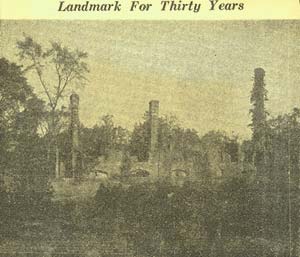 In August of the same year, the stables and out buildings of the Grange also were lost by fire, and the "Phelps Ruin" became the center of a great curiosity, attracting driving and bicycling parties from many neighboring communities. The masonry foundations were soon covered with ivy, and low plantings seemed to grow tall to protect the memory of the hospitality and philanthropy the Grange had symbolized for so long. Today the Municipal Building occupies the site.
In 1889, Mr. Phelps was sent to Germany as a Commissioner to settle an affair with the German Government concerning Samoa. The extent of his success was acclaimed in the press across the country, and the terms arranged by Mr. Phelps won a quick ratification by the Senate. This accomplishment in the field of diplomacy made Mr. Phelps the logical choice of President Harrison as Ambassador to Berlin, and in September 1889, the citizen of Bergen County sailed for a four year period of constructive work in the interests of American exporters.
Appointed to Court of Appeals
Upon his return, Mr. Phelps was appointed Judge of the New Jersey Court of Appeals by a Democratic governor n 1893, but the span of his useful life was waning, and the illness which had been so persistent made deep inroads upon his feebleness. He died In June 1894, and was buried from the Presbyterian Church in Englewood.


